

Alternatives to Traditional Restaurant Ventilation Systems
Table of Contents
- Ventless Commercial Kitchen Equipment: A Practical Alternative
- NFPA 96 Ventilation Requirements for Restaurant Kitchens
- Comparing Traditional Hoods and Ventless Options
- Demand-Control Kitchen Ventilation and Energy Efficiency
- Restaurant Ventilation Design Best Practices
- Long-Term Costs, Fire Safety, and Retrofitting Challenges
- Conclusion
- Frequently Asked Questions
Last Updated: September 29, 2026
Ventless Commercial Kitchen Equipment: A Practical Alternative
Ventless commercial kitchen equipment filters smoke, grease, and combustion byproducts internally, so it operates without a traditional hood and duct run. At The Next Idea Group, we plan these systems into restaurant layouts daily, from QSR prototypes to full-service remodels. The upside: no rooftop penetration, faster permitting, and menu flexibility in tight footprints. The catch: ventless is not a universal swap.
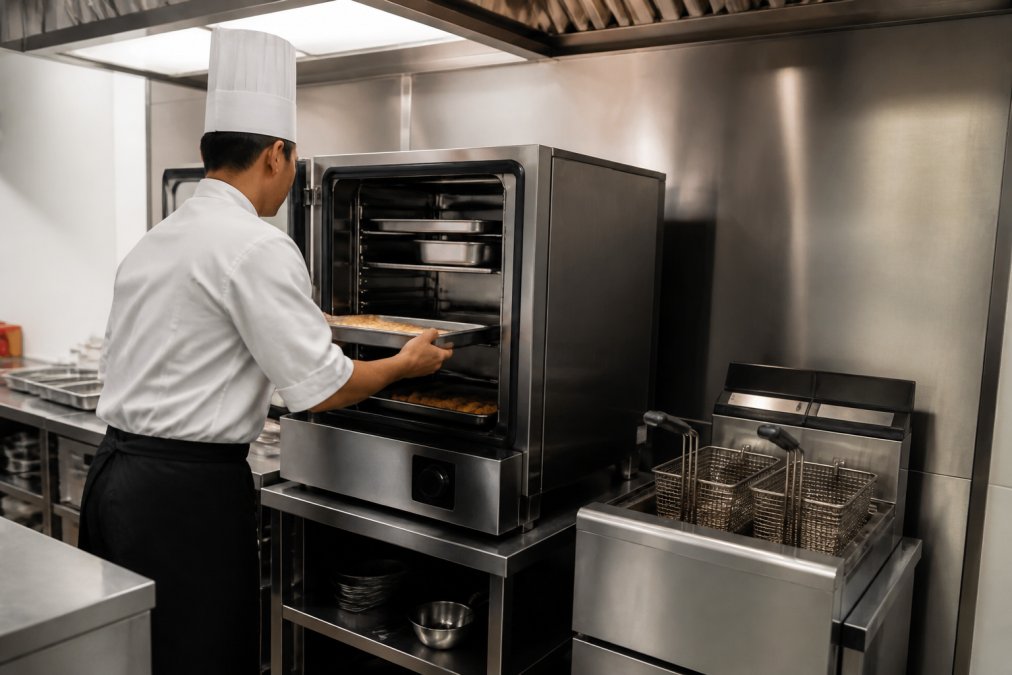
Ventless units fall into two families: appliances with built-in filtration (ovens, fryers, catalytic converters) and pollution control units that clean exhaust from conventional cooking lines. Each solves a different problem.
How Ventless Ovens, Fryers, and Catalytic Converters Work
Ventless cooking equipment captures grease and smoke at the source, then passes the air through filters or a catalytic converter before returning it to the kitchen. Catalytic converters burn off grease and odors at high temperature; charcoal and HEPA stages trap what remains. Impingement and convection cooking also produce less smoke than open-flame charbroiling.
A common mistake is assuming any ventless appliance can replace any hooded one. It cannot. A ventless fryer handles fried items; it will not run a charbroiler menu. Match the appliance to the actual menu before you commit.
Ask the manufacturer for the appliance’s specific ventless certification and filter schedule before design starts. Undersized filtration is the number one cause of failed inspections on ventless installs.
NFPA 96 Ventilation Requirements for Restaurant Kitchens
NFPA 96, the Standard for Ventilation Control and Fire Protection of Commercial Cooking Operations, is what your fire marshal and mechanical inspector use to decide whether a ventless approach is legal in your space. It governs hood design, grease extraction, fire suppression, exhaust clearance, and when listed ventless equipment can operate without a Type I hood and duct run.
The standard splits cooking appliances into two hood categories.
What “Listed” Actually Means for Ventless Equipment
Under NFPA 96, ventless cooking appliances must be listed to UL 197 (commercial electric cooking appliances) or UL 710B (recirculating ventilation systems for commercial cooking), depending on appliance type. UL 710B covers recirculating systems, the filtration-and-return-air design most operators mean by “ventless”, and confirms testing for grease capture, fire containment, and filtration performance.
The Compliance Pathway, Step by Step
- Confirm the appliance listing. Ask the manufacturer for the UL 710B or UL 197 certificate, not a marketing sheet. The certificate names the model and listing conditions.
- Check the local adoption. NFPA 96 is updated on a three-year cycle, and states adopt editions unevenly. Some jurisdictions are still enforcing editions that predate current ventless language. The NFPA 96 standard for commercial cooking operations is the starting point, but local amendments control the final call.
- Verify the state or municipal mechanical code. Most jurisdictions adopt the International Mechanical Code (IMC) or Uniform Mechanical Code (UMC), and both reference NFPA 96 for commercial cooking ventilation. The IMC has provisions for recirculating systems that some inspectors interpret strictly.
- Submit for plan review with the listing documentation attached. Plan reviewers who see the UL certificate up front approve faster than reviewers who have to ask for it.
- Schedule the fire marshal inspection after installation, not before. Fire suppression compatibility, filter access, and clearance to combustibles are all field-verified items.
Where Multi-Unit Rollouts Break Down
Rules vary by state and municipality, so what passes in one market may fail in the next. A franchise prototype approved in one jurisdiction can be rejected three states over because the local fire code adds an unanticipated requirement, a dedicated exhaust riser, a specific filter class, or a suppression agent compatibility test.
A UL 710B listing does not override local code. An AHJ can still require a Type I hood if the local amendment says so, regardless of what the appliance certificate allows. Confirm the local position in writing before you buy equipment.
Comparing Traditional Hoods and Ventless Options
Traditional hoods and ventless systems solve the same problem from opposite directions. A Type I hood with full exhaust and makeup air moves contaminants out of the building; ventless equipment cleans air in place and returns it to the kitchen. Which wins depends on your building, menu, and lease.
| Option | Best For | Key Trade-Off |
|---|---|---|
| Type I hood + exhaust | Full menus, high-volume cooking | High install cost, rooftop access needed |
| Ventless ovens | Limited space, no roof access | Restricted cooking methods |
| Ventless fryers | Adding fried items to a bar or café | Strict filter replacement schedule |
| Pollution control units | Urban sites with odor restrictions | Ongoing maintenance and cleaning |
| Demand-control ventilation | High-volume kitchens cutting energy use | Requires sensor integration |
Demand-Control Kitchen Ventilation and Energy Efficiency
Demand-control kitchen ventilation (DCKV) adjusts fan speed to real-time cooking activity instead of running exhaust at full tilt all day. Optical and temperature sensors detect smoke and heat, then variable frequency drives slow the fans when the line is idle. Savings come from fan energy and the conditioned air that would otherwise be pulled out of the building.
Skipping makeup air design is a classic error. If exhaust outpaces supply, the kitchen pulls air backward through the dining room, and doors become hard to open. It also strains the HVAC system.
::: Properly balancing these pressure differentials requires careful attention to HVAC integration tips to ensure the entire mechanical assembly functions as a cohesive unit.
Restaurant Ventilation Design Best Practices
Good restaurant ventilation design best practices start with the menu, not the equipment catalog. Map every cooking method first, then decide which stations need a Type I hood, which can go ventless, and where filtration or a pollution control unit is the only path to code compliance. Hood length, duct routing, makeup air placement, and maintenance access follow from that map.
- Group heavy-grease cooking (fryers, griddles) under one hood run
- Keep ventless units away from high-heat stations to protect filtration
- Design filter and grease-trap access so staff can service them without ladders
- Size makeup air to match exhaust and integrate it with the HVAC system
- Plan fire suppression coverage around the actual cooking line, not the room
Design the ventilation system around the menu and the service volume, not around a single appliance. The equipment follows the operation, never the reverse.
Long-Term Costs, Fire Safety, and Retrofitting Challenges
Most guides on ventless equipment stop at the purchase order. The real decision plays out over five to ten years, where ventless and traditional hoods diverge in ways the spec sheet never shows: total cost of ownership, fire safety and insurance mechanics, and retrofit constraints.
Total Cost of Ownership: Filters vs. Hood Cleaning
The purchase price of a ventless appliance is only the entry fee. Its recurring cost structure differs completely from a traditional hood.
Fire Safety and Insurance Implications
Ventless equipment still needs fire suppression compatibility, and the suppression system must match the appliance listing. A UL 710B-listed appliance is tested with specific suppression arrangements; swapping in a different agent or nozzle configuration can void the listing and create an insurance problem.
Indoor Air Quality: What the Filtration Actually Removes
Ventless systems return air to the kitchen, so filtration performance is an IAQ question, not just a code question. Cooking produces particulate matter (PM2.5 and ultrafine particles), volatile organic compounds (VOCs), carbon monoxide from gas appliances, and grease aerosol. A well-maintained multi-stage system, grease baffle, high-efficiency particulate stage, and activated carbon or catalytic stage for odors and VOCs, captures most of these before the air returns.
Retrofitting Historic and Constrained Buildings
Historic buildings and older urban shells are where ventless and pollution control units earn their place. The constraints are predictable: limited ceiling height that cannot fit a hood and duct run, no roof access for exhaust termination, load-bearing walls that cannot be penetrated for duct routing, and preservation rules restricting exterior modifications.
Ventless shifts cost and risk rather than eliminating them. The operators who win are the ones who model the five-year TCO, document their filter service from day one, and confirm the building can physically support the menu before they sign the lease.
Conclusion
Ventless equipment, DCKV, and pollution control units give operators real alternatives to traditional restaurant ventilation systems, but only when the choice matches the menu, the building, and the local code. Getting that match right is a design problem before it is an equipment problem.
Frequently Asked Questions
What are the best ventless hood systems for restaurants?
Ventless hood systems use sensors to adjust fan speeds, offering energy savings. For full ventless cooking, certain ovens and catalytic converters can eliminate the need for traditional hoods. These systems are ideal for small kitchens or buildings without rooftop access, but they require regular filter maintenance to stay compliant with NFPA 96.
Can a restaurant operate without hood vents?
Yes, a restaurant can operate without traditional hood vents by using ventless commercial kitchen equipment such as ventless fryers, ovens, and pollution control units. These alternatives filter grease, smoke, and odors internally, allowing compliance with NFPA 96 and local codes. However, they are best for limited menus; high-volume grilling or charbroiling may still require a Type I hood.
What is the best air ventilation system for a commercial kitchen?
The best system depends on your menu and building. Demand-control kitchen ventilation (DCKV) reduces energy use and is ideal for high-volume kitchens. For spaces without ductwork, ventless ovens and fryers are effective. Always consult a professional to ensure your system meets NFPA 96 and local building codes.
What are the disadvantages of ventless hoods?
Ventless hoods have limitations: they require frequent filter cleaning or replacement, may not handle heavy grease loads from charbroilers, and can be costly to maintain. They also have lower capacity than traditional hoods, so they suit cafes and bars more than high-volume restaurants. Additionally, some local codes restrict their use for certain cooking methods, so verify compliance before installing.
How do ventless cooking appliances comply with NFPA 96 standards?
Ventless appliances comply with NFPA 96 by using integrated filtration, catalytic converters, or electrostatic precipitators to remove grease and smoke before recirculating air. They must meet specific testing standards (e.g., UL 710B) and be installed per manufacturer instructions. Regular maintenance and inspections are required to ensure ongoing compliance and fire safety.