

7 Benefits of Modular Kitchen Equipment for Restaurant Startups
Last Updated: October 31, 2026
Quick Summary
Modular kitchen equipment is factory-built cooking, refrigeration, and prep stations that are delivered, connected, and rearranged instead of built into walls. For restaurant startups, it lowers initial investment through phased buying, shortens construction schedules, and lets you reconfigure the kitchen as your menu and business model change.
- Buy stations in phases, starting with refrigeration, then primary cooking, prep surfaces, and dishwashing.
- Confirm voltage, gas line size, and ventilation match the space before ordering any module.
- Order equipment only after permit drawings are approved to avoid expensive rework.
- Station-level refrigeration keeps ingredients close to the line and protects freshness.
- Document a standard module package once so each new location replicates the same kitchen.
Table of Contents
- Why Modular Kitchen Equipment Fits the Way Restaurant Startups Actually Open
- Benefit 1: Lower Initial Investment and a Clearer Total Cost of Ownership
- Benefit 2: Faster Construction Schedules and Earlier Opening Dates
- Benefit 3: Operational Efficiency and Labor Savings Built Into the Layout
- Benefit 4: Space Optimization and Flexible Configuration for Tight Footprints
- Benefit 5: Better Food Storage, Freshness, and Consistent Dishes
- Benefit 6: Energy Efficiency, Waste Reduction, and Lower Operating Costs
- Benefit 7: Scalability for Multi-Unit Growth and Changing Business Models
- Turning Modular Equipment Into a Kitchen That Performs
- Frequently Asked Questions
Why Modular Kitchen Equipment Fits the Way Restaurant Startups Actually Open
Modular kitchen equipment is factory-built cooking, refrigeration, and prep equipment grouped into freestanding, interchangeable stations that can be delivered, connected, and rearranged instead of built into the walls.
Here’s the tension most guides skip: a startup’s menu is a guess in month one and a fact by month twelve. Fixed kitchens lock in the guess. Modular kitchens let you correct it.
Below, we’ll walk through each benefit and where it actually shows up on a project schedule.
What Counts as Modular Kitchen Equipment
Modular kitchen equipment is any commercial unit built as a self-contained, movable module rather than a permanent fixture. Think roll-in refrigeration, freestanding ranges, stacked combi ovens, and prep tables on casters.
- Freestanding cooking lines that connect to utilities and roll into place
- Modular refrigeration in stackable or roll-in formats
- Prep stations built as single units with their own work surface
- Ventilated or ventless hoods sized to individual stations
- Dishwashing modules that slot into a defined zone
The common thread: each piece can be swapped, expanded, or relocated without demolition. That is the whole point.
Watch out: buying modular units without confirming utility connections first is the mistake that erases the benefit. A module that needs a different voltage or gas line than the space provides becomes a fixed cost anyway.
Benefit 1: Lower Initial Investment and a Clearer Total Cost of Ownership
Modular equipment can lower the initial investment because you can buy stations in phases instead of committing to a full custom build up front. For guidance on planning those costs across multiple locations, see our how to budget for multi-unit franchise architecture.
Most guides stop at the sticker price. A startup needs a framework. Here is how we walk founders through the decision:
- New modular equipment: Highest upfront cost, but full warranty, known service schedule, and predictable replacement parts. Best when you plan to keep the concept for five or more years.
- Used modular equipment: Lower upfront cost, but inspect for refrigerant type, electrical compatibility, and remaining useful life. A used unit that needs a new compressor or a voltage converter erases the savings.
- Leased modular equipment: Lowest upfront cash outlay, but total payments over the lease term often exceed purchase price. Best for pop-ups, seasonal concepts, or testing a menu before committing.
- Modular vs. fixed custom build: A fixed build bundles equipment into construction costs, making it hard to isolate equipment spend. Modular units carry their own line-item price, warranty, and service contract, so you can compare apples to apples.
A common pattern among startups is to open with the stations your menu truly requires, then add capacity as revenue supports it. That staged buying keeps early capital tied to proven demand. But staged buying only works if you sequence purchases correctly. Here is a practical order we recommend:
- Refrigeration first, it protects inventory and is the hardest to add later without disrupting workflow.
- Primary cooking station, the one unit your core menu cannot run without.
- Prep and plating surfaces, these can start simple and scale with volume.
- Dishwashing, often deferred, but a bottleneck if undersized from day one.
- Specialty or expansion modules, combi ovens, ventless fryers, or additional refrigeration added as demand proves out.
Before ordering any module, confirm the utility connections (voltage, gas line size, ventilation) match the space. A module that needs a different voltage or gas line than the space provides becomes a fixed cost anyway.
Savings often show up in the total cost of ownership, not the sticker price:
- Fewer change orders during construction
- Predictable replacement costs per module
- Lower demolition cost when the menu shifts
- Simpler maintenance contracts tied to individual units
For a deeper look at planning costs across multiple locations, contact The Next Idea Group for current pricing or a quote.
Benefit 2: Faster Construction Schedules and Earlier Opening Dates
Faster construction schedules come from moving equipment fabrication off-site. Modular units are built in a factory while the space is still being prepped, so installation becomes a delivery and connection task rather than a build.
Earlier opening dates follow directly. Every week you shave off the schedule is a week of revenue you start collecting sooner.
Restaurant architecture work of this kind includes coordinating kitchen layout with the overall construction sequence, so equipment delivery is timed to the build. For more on the firm’s restaurant design services, review our restaurant hospitality design services.
Watch out: ordering modular equipment before the permit drawings are approved can force expensive rework. Sequence the order after the layout is locked.
Benefit 3: Operational Efficiency and Labor Savings Built Into the Layout
Operational efficiency in a modular kitchen comes from placing each station where the cook actually needs it, not where a wall happened to be. Good equipment placement cuts steps, and fewer steps means faster service during a rush.
Labor efficiency follows the same logic. When prep, cooking, and plating sit in a logical sequence, staff spend their time working rather than walking.
- Prep zones next to refrigeration, not across the room
- Cooking lines arranged in the order dishes are built
- Plating surfaces within arm’s reach of the pass
- Dish return routed away from the cook line
An ergonomic workspace also reduces fatigue on long shifts. That shows up in retention, which is a real cost for any food-service business.
Benefit 4: Space Optimization and Flexible Configuration for Tight Footprints
Space optimization is where modular equipment earns its keep in small footprints. A tight back-of-house can still run a full menu when each station is sized to fit and configured to stack or nest.
Flexible configuration means the same square footage supports different service models. A fast-casual setup at lunch can shift to a fuller dinner line without new construction.
A small restaurant kitchen equipment list often includes:
- One multi-function cooking unit instead of three single-purpose ones
- Stacked refrigeration to free up floor space
- Casters on prep tables so the room can be reconfigured
- Wall-mounted shelving over stations, not separate storage
To see how space-optimized layouts look in real projects, review our kitchen design work.
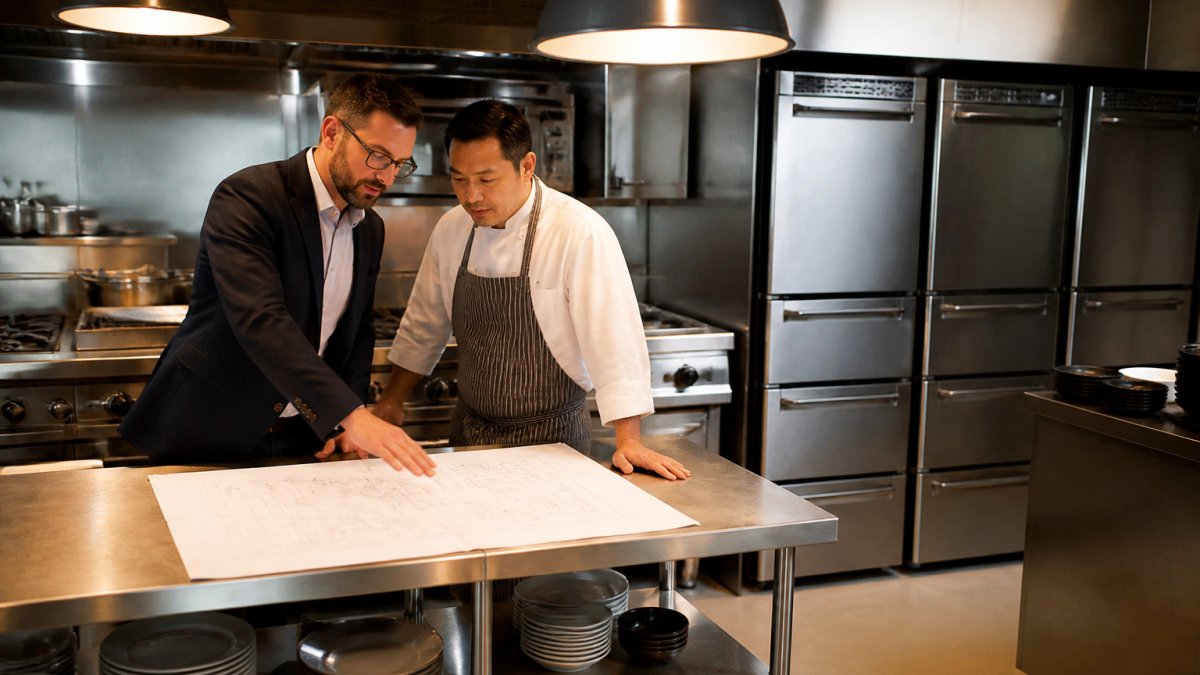
Maximizing every square inch requires a strategic approach to vertical integration and small kitchen storage solutions that ensure essential tools remain accessible without cluttering the active workspace.
Benefit 5: Better Food Storage, Freshness, and Consistent Dishes
Better food storage starts with refrigeration that holds temperature evenly and gives staff clear access. Modular refrigeration units are sized to the station they serve, which means product moves less and stays fresher.
Food freshness depends on the cold chain holding steady. Consistent dishes depend on the same thing: the same ingredient, handled the same way, every service.
- Station-level refrigeration keeps ingredients close to the line
- Clear labeling zones reduce cross-use and waste
- Even temperature protects quality during peak hours
- Defined storage capacity prevents over-ordering
A consistent dish is a repeatable dish. Repeatable dishes build a restaurant’s reputation.
Benefit 6: Energy Efficiency, Waste Reduction, and Lower Operating Costs
Energy efficiency in a modular kitchen comes from running only the stations you need. A single combi oven heating for one dish wastes far less than a full cooking line fired up for a slow afternoon.
Waste reduction follows the same principle. Right-sized equipment means less overproduction and less ingredient waste.
Energy costs and ingredient waste are often where modular setups pay back, and sustainable design can support that. Explore our California sustainable restaurant design approach.
- Right-sized units run less often at full load
- Ventless or targeted hoods cut ventilation load
- Station-level shutoff during slow periods
- Smaller batches mean less spoilage
Benefit 7: Scalability for Multi-Unit Growth and Changing Business Models
Scalability is the benefit that matters most once you plan a second location.
Here is how modular scalability actually works in practice, compared with a fixed or custom-built kitchen:
| Scenario | Fixed/Custom Kitchen | Modular Kitchen |
|---|---|---|
| Add a delivery-only menu | Requires new equipment and possibly rework of ventilation or electrical | Add a dedicated packing station and a separate fryer module; no wall changes |
| Shift to seasonal menu | Equipment sits idle or is removed at cost | Swap or store modules; reconfigure line for the season |
| Expand to a second location | Each build is a new design and construction project | Document the module package once; replicate at each site |
| Test a new service line (catering, retail) | Often requires a separate prep area or off-site kitchen | Add a roll-in refrigeration unit and a prep table on casters; reconfigure as needed |
| Downsize or relocate | Equipment is built in; moving means demolition | Modules disconnect and move with you |
The key mechanism is documentation. When you standardize on a modular package, you create a repeatable kit of parts: the same refrigeration, the same cooking line, the same prep surfaces.
Changing business models also get easier. A concept that adds delivery, catering, or a retail counter can add a module instead of rebuilding.
Scalability is not just about growth, it is about the ability to change your business model without changing your walls. Modular equipment gives you that option at the unit level, not the building level.
For brands planning a rollout, prototype designs and scalable construction packages can help keep each location consistent.
Turning Modular Equipment Into a Kitchen That Performs
The real challenge is not picking equipment. It is fitting every module into a layout that satisfies the health department, the utility connections, and the way your line actually cooks.
That is where The Next Idea Group can help. The firm brings over two decades of experience in shaping environments, and its services include space planning, permit drawings, and construction documents.
Get started with The Next Idea Group and open a kitchen built to adapt, not to be torn out.
Frequently Asked Questions
What is modular kitchen equipment?
Modular kitchen equipment is freestanding, standardized commercial equipment built to fit together in repeatable configurations. Instead of custom-built ranges, hoods, and refrigeration tied to one footprint, you buy compatible units that can be rearranged, expanded, or moved to another location. For restaurant startups, that means the kitchen can be planned as a set of zones (prep, cook, cold storage, dish) and adjusted as the menu or volume changes, without a full demolition and rebuild.
How does modular kitchen equipment make a restaurant easier to expand?
Because the units are standardized, a proven layout can be copied from one location to the next with minimal redesign. Franchise and multi-unit operators can develop a prototype kitchen, then repeat it across new sites, which shortens design and permitting cycles and keeps the guest experience consistent. When a location outgrows its volume, you add capacity by swapping in a larger modular unit or adding a station rather than reworking the whole kitchen.
How should a startup choose commercial kitchen equipment?
Start with the menu, not the catalog. List every dish, then map the cooking, prep, and storage steps each one requires. From there, size the equipment to your projected peak-hour covers, confirm utility requirements (gas, electrical, ventilation, water) with your architect, and check that each unit fits the available footprint and clearances. Compare total cost of ownership, including installation, maintenance, and expected service life, rather than sticker price alone.
What equipment does a small restaurant kitchen need?
A practical small restaurant kitchen equipment list usually covers a commercial range or combi oven, fryer, prep tables, a reach-in or undercounter refrigerator, a freezer, a dish machine, hand sinks, shelving, and a ventilation hood sized to the cooking equipment. The exact list depends on the menu and service style. A modular approach lets you start with the core stations and add units as volume grows, which keeps the initial investment controlled.